
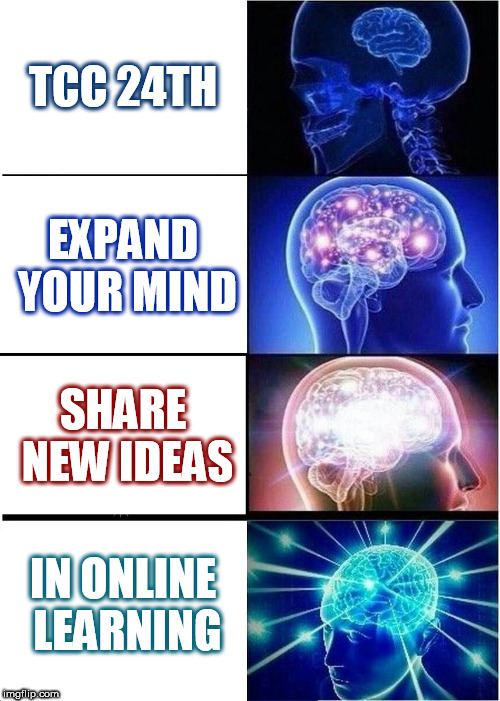
An invited pre-conference session for the 24th Teaching, Colleges, and Community Online Conference.
Do easily shared social media content like memes and animated GIFs represent the worst elements of internet culture? Are they inappropriate for academic work? Are there purposeful applications for “silly media”? The characteristics of these media forms can help attract attention to concepts. Humor may ease online communications or provide discussion points for in-class presentations. Rather than just re-sharing media others have made, what can you or your students accomplish by creating your own?
Mostly associated with pop culture references, the concept of the meme has its roots in the scientific community. This presentation will suggest ways we can augment online teaching by just adding images to words, not as an aesthetic, but for visualizing examples, applying metaphors, and opening discussion topics.
Like memes, animated GIFs are often used to generate a laugh, a smile, maybe just a ¯\_(ツ)_/¯. But considering them as short-form video, their looping structure is effective for demonstrating natural processes or showing hands-on techniques where repetition can aid understanding.
Learn what you and your students might accomplish by creating your own meme images and animated GIFs. These media we see mostly “just to be funny” in social spaces, with your creative teaching idea, might be used in a much more meaningful way.
A recording of the session is now available at the TCC web site.
Memes Made by Participants During the Session



LINKS and more
Previously on Silly Media (related materials)
- Meme Media: Attention-Grabbing Images And Animated Gifs (UDG Agora Studio)
- Making Short Form Videos(UDG Agora Studio)
- Affordances of Silly Media (ISS Institute workshop)
- One Does Not Simply Make NetNarr Memes? (Network Narratives course)
- NetNarr GIF Reader (Network Narratives course)
Memes
- The Selfish Gene (1976) by Richard Dawkins
We need a name for the new replicator, a noun which conveys the idea of a unit of cultural transmission, or a unit of imitation. ‘Mimeme’ comes from a suitable Greek root, but I want a monosyllable that sounds a bit like ‘gene’. I hope my classicist friends will forgive me if I abbreviate mimeme to meme. If it is any consolation, it could alternatively be thought of as being related to ‘memory’, or to the French word même. It should be pronounced to rhyme with ‘cream’.
Examples of memes are tunes, ideas, catch-phrases, clothes fashions, ways of making pots or of building arches. Just as genes propagate themselves in the gene pool by leaping from body to body via sperms or eggs, so memes propagate themselves in the meme pool by leaping from brain to brain, via a process which, in the broad sense, can be called imitation.
- The mass shooting in New Zealand was designed to spread on social media – (The Verge)
- How the Christchurch terrorist attack was made for social media – (CNN)
- Happy Cat -the first LOLCat – (Know Your Meme)
- Photos from the Early 1900s Prove LOLcats Were Around Long Before the Internet – (Petapixel)
- Harry Whittier Frees (Wikipedia)
- The ‘Distracted Boyfriend’ Meme’s Photographer Explains All (Wired)
- Know Your Meme is one of the best sources to research memes.
- Meme documentation (tumblr)
- Classic tumblr memes
- 38 Great Memes of 2017 (Buzzfeed)
- Making Sense of Memes: Where They Came From and Why We Keep Clicking Them (Marion Provencher Langlois, Inquiries Journal)
- Explainer: what are memes? (The Conversation)
- Memes in Digital Culture (book by Limor Shifman)
- The Wired Guide to Memes (Wired Magazine)
- Why Millenials Are Making Memes About Wanting to Die? (Deirdre Olsen, Salon)
- Dank learning system autogenerates memes (TechCrunch)
- At ROFLCon, watching memes go mainstream (The Verge)
- @ClassicArtMeme
- Dank learning system autogenerates memes (TechCrunch)
- Why We Post – Social Media Through the Eyes of the World “a global anthropological research project on the uses and consequences of social media” (University College London)
- Memes: Shared Experience, Implicit Meaning and Social Commentary (Glossi Mag)
Purposeful Memes
- The 42 Best Science Memes On The Internet (BuzzFeed)
- Wholesome Memes (Know Your Memes)
- @Wholesome Memes (twitter)
- @RespectfulMemes
- English Learning Memes – “These memes help you learn English in a fun and interesting way. Click on the meme to get a more detailed explanation of the vocabulary or grammar mistake you should avoid making. “
- How to Learn Killer English Vocabulary from 21 Popular Memes – “Here, we are going to talk about memes and how they can be your new favorite tool for learning English. Practicing English with memes is another way to learn through popular culture! That means you will learn about language and culture in the English-speaking world.”
- Teaching and Learning Memes – (curated in interest by BYU Center for Teaching & Learning)
- CSC263 Educational Memes – contributed by the students and TAs of CSC263 (Data Structures and Analysis) University of Toronto
- 5 Ways to Use Memes With Students (ISTE)
In an undergrad class on "Vision and Textuality" we're doing a range of experiments in text visualization, labeling practice, and data curation. But I think the part where I asked them to make memes based on "Song of Myself" has elevated to my favorite assignment of all time. pic.twitter.com/Sf7gasiPvl
— Doug Guerra (@arithmatelle) February 21, 2019
Asked my students to do stats memes for extra credit and *was not disappointed*.#rstats #memes #statistics pic.twitter.com/3um9qXLTmL
— Virginia Matzek (@v_matzek) March 30, 2021
Meme Making Activities
- imgflip Meme Generator
- TCC 2019 Challenge: Make a Meme for Why Attend TCC?

- Networked Narratives Meme Acivities
Animated GIFs
“I ran across this animated GIF of C. elegans on the move while putting together the previous post on optogenetics. It’s the work of Bob Goldstein of the University of North Carolina’s biology department, who has created a large body of microphotographic cinema. This little looping movie of a sinuous nematode seems nearly the perfect marriage of format and subject: the winking, primitive, robust genre of the animated GIF; an ancient, simple, vermiform specimen of multicellular life. It’s as if C. elegans had swum down through the aeons to intersect with an image-making format precisely engineered to express its particular qualities.”
Great Animated GIFs of Science (GearFuse)
- A 25 Year History of the Animated GIF Told by GIFs (The Atlantic)
- The Story of GIF (2103)
- If We Don’t Remember Me (tumblr)
- Cinemagraphs (Kevin Burg & Jamie Beck)
- Short Form Video Studio (UDG Agora)
- The History of GIFs (Mashable)
- Teaching Sign Language (Sign With Robert on giphy)
- How GIFs are changing the way we talk science (PHYS.org)
- Cool Science GIFs (tumblr)
- Animating Public Domain Art (GIF IT UP, Digital Public Library of America)
- 6 GIF Artists Hack the Language of Propaganda (Protest Art)
- Educational GIFs
- These 20 Educational Gifs Will Teach You More Than A Textbook Can (boredpanda)
- How to create ExplainerGIFs (CommonCraft)
- 25 GIFs that explain how things work (Relatively Interesting)
- Gifpop create lenticular prints from GIFS
- A History of the GIF (links from Michael Branson Smith)
- The GIF THat Keeps on GIFFING (how to guide for students, University of Mary Washington)
- The Long, Remarkable History of the GIF (Popular Mechanics)
- These Incredible Animated GIFs Are More Than 150 Years Old (Wired)
- So Long Animated GIFs, Hello Cinemagraph (HuffPost)
- re/animating GIFs (Other Cinema)
- 30 Artists Proving That GIFs Are The Next Great Art Form (BuzzFeed)
- Hummingbird GIF (Biomorphosis)
The geometry of a perfect parallel park. pic.twitter.com/rUUouEydsh
— Simon Pampena (@mathemaniac) November 25, 2016
GIF Making
- Giphy GIF Maker
- TCC 2019 Challenge: Make a GIF From this One Video
- ISS Institute Box of Web Tricks (November 2017)
- Networked Narratives (2018-2019)


3 Pingbacks